Showing posts with label Australian history. Show all posts

Friday, June 27, 2014

One day in history

Each day we had passed a tourist sign that pointed down a side road to Patchs beach (not a spelling mistake, its possible there was a person named Patchs). Today we followed that road to take a look. It was worth the effort. The beach is another part of that same beach that is close to the caravan park where we are staying and the sand stretches for miles into the far distance. I could just make out the glint of sunlight on the window of a vehicle but not the vehicle.
The beach is used by surf fishermen and in different places there is access to the beach for four wheel drives. Not far from where we walked to the sand I spotted a single man up to his waist in the sea gamely trying his best to catch a meal.
Leaving the fisherman behind we again drove from Wardell to Alstonville because the scenery is so beautiful along that road. This time we were to visit the house of one of the founding members of the township, Ambrose Crawford. It has been converted into a museum.
The house is weatherboard and was Crawford's second house, built especially for his wife. Their first home was a very simple cottage and that no longer exists.
When the family moved out the house was gifted to the local council and it was used for as a baby clinic and as a base for Meals on Wheels but a few years ago the Historical Society asked for and were given the building to create a museum of life in the early 20th century. One of the active members of this society is one of the daughters of the family that lived here, she is now in her nineties. We were lucky enough to be looking around the house when she called in and she pointed out this telephone that she told us was installed in 1913 and told how she would love to listen in to the conversations with the earpiece held to her ear.
Each of the rooms was displayed to show off different features and apparently the displays are changed fortnightly. In the bedroom was a collection of childrens clothing and toys. One large standing doll caught my attention, it was the size of a four year old child and had the most beautiful face and jointed arms and legs. It was standing as if looking down into a little dolls bed in which lay another small doll.
In the living room was yet another doll, this time a full sized adult. Maybe this was a shop display doll. Again the face was beautiful. The pianola (I think that is what it is) was a popular piece of furniture in the 1920's. I have a friend who treasures his old pianola and has hundreds of rolls of music.
Our holiday in the Ballina area is at an end and tomorrow we drive home again to continue with our regular lives. It will be good to be home but I have enjoyed seeing so many of the interesting places down here.
AJ


Tuesday, June 24, 2014

To the woods!

When we first arrived in Ballina township we called into the Information Office – most large towns have such a place, it is where travellers can get information about the town and district and even learn where to stay, where to eat and any special events that might be happening during the time of their stay. The helpful young lady who rushed to our assistance gave us quite a lot of help and insisted that we should visit Victoria Park. Apparantly, before the timbermen, who were chasing the red cedar, had destroyed most of the natural rainforest, a tiny parcel of 8 hectares had been secured from devastation as a reminder of what the country once was. Both Colin and I are nature lovers so this was definitely on our “to visit” list. Actually, it was not just the timbermen who destroyed the natural bush, the government did too – they sold much of the tree covered land where the cedar had been taken, for people to farm - on condition that they cleared it of bush.
We had Victoria Park to ourselves. A timber boardwalk has been created to take you through the small patch of rainforest without touching the ground.
The reserve is actually larger than the 8 hectares of rainforest, and regeneration in the area surrounding that remnant of forest will increase its size in time. Large rainforest trees often have what is known as “buttress roots” They are very shallow penetrating which means that in ultra strong winds the massive trees will topple over and cause a domino effect with their fall, forcing over other trees.
At last I managed to get a photograph of myself! I had to set the camera up and work out how to get into the shot and persuaded Colin to press the button. For some reason we had to have three tries before he actually managed to press the button firmly enough for the shot to be taken! No, I was not inside the rainforest where we were asked to stay on the boardwalk, this tree was on the very edge beside the carpark! The rest of the rainforest is behind it.
Another place that our helpful Information Ofice girl told us about was Summerland House. Actually my tour guide son had told us about it only a week earlier and recommended that we try to visit. Anyway, we did visit. This is a farm that is worked by handicapped people and is obviously a very productive and successful farm. Avocados, macadamia nuts and hydrophonic tomatoes are the main crops grown and a tractor tour of the farm was a real eye opener to the success of the place.
As well as the farm there are shops where gifts can be bought, farm grown groceries can be bought and a nursery where plants can be bought.
I would have loved to have bought a few of the plants that were here – they looked so strong and were not expensive either. Maybe we could call in again on the way home. Its four days before we pack up to leave this caravan park (which is deserted now the weekend is over!)
The evening light was beautiful when I looked out of the window of our cabin back at the caravan park so we hastily jumped into the car to get to where we could see the sun setting over the water. It was dazzling bright and not good for photography so I waited until the sun dropped out of sight. The clouds were beautiful so I contented myself with a shot of them. Driving back to the camp again the tiny clouds overhead and in the East were reds and yellows. It makes you feel good to see the beauty that nature can provide!
We intend to head South tomorrow. Fingers crossed that the weather stays as good as this!
AJ

Saturday, March 2, 2013

Unspoiled Rainforest


I mentioned a couple of days ago that Colin and I had visited a tiny patch of rainforest called Victoria Park. Today I would like to show you a few of the photographs I took there. The young man in the Ballina Information Office was quite passionate about this little park telling us how it was the only area left of the pristine rainforest when the timber men finished their destruction of the local cedar and pine trees that were used to make packing cases for the banana crops.
Rainforests are known for their huge buttress rooted trees and this one abounded with them.
For those of you who have not been into a rainforest, they are often quite dark, not overly crowded with leaves in the lower levels but the roof of the forest is a mat of leaves that shut out the sunlight to the ground below.
Knowing this I dug out the flash gun and extension lead and attached it to my camera before stepping out of the sunlight. It is a bit tricky using an unattached flash gun but I gripped it with the last two fingers of my right hand, guiding its direction with my left hand before that hand was used to support the camera. When you want something badly enough you work for it!!
There were patches of brightness along the way where large trees had been blown down by strong winds, these trees had crashed down tearing off branches of other trees on their way and leaving huge windows of light – and dead leaves.
Although the 300 year old strangler fig has long gone there is another that is growing up and will one day rival the first for size. The fruit from a strangler fig will be deposited in the angle of a branch of an established tree, either falling there or being dropped there by a bird or animal and starts to grow in the moist leaf litter that is caught there.
There were some great signs in the rainforest that were worthy of a photograph.
Without a person standing nearby it is not easy to see how large this tree is. You will have to take my word for it!
My last picture for today is also of a sign.
I thought the signs rather clever, I can't pronounce the names, I wonder if you can?
(Clicking on the picture enlarges them)
AJ

Thursday, February 28, 2013

Lakes and oceans


This is the last full day of our short break and we really made the most of the time we had. After a brief and quite light shower we packed the car with our lunch and my cameras and off we set – first to see the lake that is at the northern end of Lennox Head township. Lake Ainsworth is only a small lake but at the moment it looks beautiful. Apparently it is not always so attractive and judging by the odd bits of weed floating about it will not be all that long before the water hyacinth takes over once again and turns the clear waters green and lawn like.
Driving past the well located caravan (“tourist”) park along a gravel road I turned the car into a side track and we found ourselves at the ramp where four wheel drives can access the “Seven Mile Beach”. After watching a family of tiny quail (birds) scratching and feeding in the short grass just in front of the car we climbed out and over the dunes to see the beach. We hadn't been there very long when a couple of sea horses appeared!
You never know quite what you will find in this part of the world!
Our plan was to drive to Evans Head, however on the way we had to drive past Wardell – the little town we turned into yesterday on our drive to Thursday Plantation. I had read about this place being historic or having historic buildings so once again I turned the car to leave the highway and this time swung left to explore in a different direction. The road I took looped back under the highway and sure enough, led to the old part of the town.
The old pub has no name and doesn't even show the name of the proprietor over the door but judging by the cars out front it still operates as a pub. Across the road stands a beautiful old brick building that was once a branch of the National Bank of Australia – the faded gold letters are still above the door on the corner of the building. A sign board beside the structure shouts “Sold” so it will not crumble into disrepair as so many old buildings have. Behind where I was standing to take this photograph stands a huge Catholic Church. I would say that at one time Wardell must have been a sizeable town to warrant such large buildings and such a wide road.
The Pacific Highway that cuts across Wardell passes over a lifting bridge, further indication that this area was once busy both on the river and on the land.
I just had to stop the car after driving under the highway a second time, I hadn't seen it before but this time I spotted some amazing artwork on one side of the bridge.
Good, isn't it?
Evans Head proved to be another interesting place and although I took several photographs I will save them for another day – because I want to show you something different – we took a turn off the highway before we reached Ballina to take a drive along the narrow neck of land that lies between the river and sea. I did not expect it to be populated – it seems so out of the way from shops and amenities but there were plenty of expensive looking homes with a fair amount of garden around them as well as several farms planted with sugar cane. The road seemed to travel along the river for ages and ages and just as I was beginning to think I should turn around, we mush surely be at the tip, we came across a ferry.
So really the people who live on this side of the river do not have so very far to drive after all! They can tootle up the road and wait for the ferry to come back over for them and it saves them having to drive about 30 kilometres. The ferry is motorised but is guided by two cables. Maybe it pulls itself over by these cables, I don't know.
The prices of transport look a bit expensive – but petrol being as high as it is at the moment, I guess it does work out to be a saving.
Colin and I pack the car and leave Lennox Head tomorrow morning, We might call in to visit a couple of places on the way home though. Our dogs will be happy to see us again!
AJ

Wednesday, February 27, 2013

Exploring again


Once the morning showers had passed we loaded the picnic box in the car and headed South to Ballina. Our first stop was at the Ballina Manor, we had been recommended to take a look at this historic building by our son, Steven. The building itself is timber and not particularly remarkable.
It was built in 1925 as a Wesley Girls School and has been through a few transformations – but in 2000 it was purchased, Heritage Listed and restoration was undertaken – additions to the building removed and painting undertaken using the colours of the era, furnishings used between 1925 and 1931 (the year the school closed) were purchased and later that same year the refurbished Manor House was opened with great pomp and ceremony.
We were given a guided tour through the building calling in to see the rooms (they are hotel rooms with en-suite bathrooms) and given a description of how the room was originally used.
This picture is a small part of the dining room (it was originally the dining room for the girls). I found the décor very attractive and we both found the story of the building really interesting.
Leaving Ballina behind us we made our way to Thursday Plantation, a Tee-tree plantation, once again we enjoyed a free tour, this time of the gardens and rainforest. Throughout the garden and rainforest are sculptures.
There used to be an annual sculpture competition at which there would be an acquisition prize – but apparently some of the sculptures just never went home even if they had not been awarded the acquisition prize! Being a gardener I was very interested in all the varieties of ginger and herbs that were growing there. The young gardener came over and talked to us and he responded enthusiastically to all my queries. I even had the temerity to beg a little piece of root of one of the gingers! Yep! I have some to see if I can get it growing!!! One of the rather unusual flowers we saw there was a “bat flower” what a wonderful thing it is.
No! I didn't ask for a bit of it!
Our next interesting stop was Victoria Park. That is a pocket of unspoiled natural timber – a tiny patch that had never been logged by the timber getters in the early days of white settlement. Originally it had contained a massive fig tree that could be seen from miles away – it had been spotted from out at see by Captain Cook as he sailed up the east coast of Australia in 1770. However that tree is long gone. It was struck by lightning many years ago.
I took many photographs in the rainforest but I will not include any here. . . . because the little town of Alstonville might be more interesting to show here.
The town is attractive, small and popular. It has a country market that draws people from far and wide. Here we are on a Wednesday and the pub is humming with the voices of the many patrons which proves that the town is popular everyday, not just on market days.
My eye was caught by an obelisk standing near the war memorial.
The young man who was awarded the VC was killed in Ypres at the age of 20 in September 1917.
AJ

Tuesday, August 7, 2012

Beauty lost

My Sunday drive took me past a wonderful old homestead. Years ago in the company of several other video enthusiasts plus a couple of actors in period costume, I visited this beautiful old house. It was open to the public and completely furnished as it had been left. At the time we were told that two sisters lived here up to the ends of their lives. After that the place was given a complete new coat of paint (It used to look like a haunted house!) and the interior cleaned up and made presentable. The caretakers of the place provided teas and scones in the large kitchen. The garden too had been scoured of rubbish and made suitable for public scrutiny. So you see, I have vivid memories of the place.

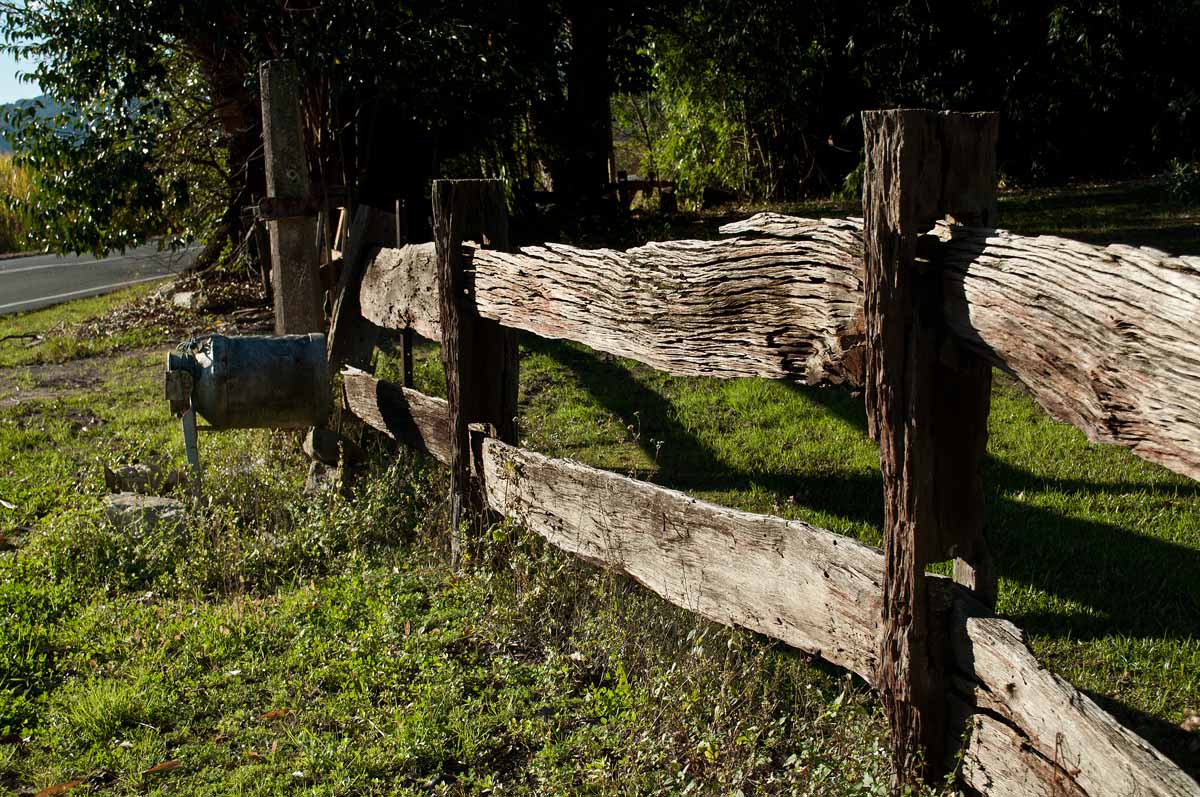
A typical fence made in the early days of Australia's white settlement was one made from native timbers and constructed without nails. The boundary fence to the property still stands as a testament to those difficult times and shows that there must have been a home here long before this two storey structure was put here.
The house still looks very imposing even though rust is showing through the paint of the iron lacework.
The garden is now overgrown and the white fence a bit the worse for wear but thanks to being able to zoom in on a photograph I can see that the original lace curtains still hang in the windows!
From the state of the lacework you can tell that it has been made of iron and not zinc or aluminium (as the lacework on my veranda is). This will be hand forged and most likely be worth a bit of money to someone who is restoring an old home somewhere!
It is a shame that once again this beautiful looking place is slipping back into a state of decay but the upkeep on a timber home is very high. There could be all sorts of reasons for it being left to rot.
I would not be at all surprised that the place is riddled with white ants and cursed with asbestos.
You can see it was once magnificent.
AJ
I have just found a story about Lisnagar Homestead and encourage you to follow this link to read more about it. This is an article written by a family member.

Thursday, March 29, 2012

sightseeing in Canberra


On the day that was set aside for sight seeing as a group what does the weather do? Oh yes! There was a thunderstorm through the night and it was not exactly “wild” but it certainly wasn’t sunny when the coach pulled up to the front door of the Country club. (The Country Club is where the Convention is being held.) A row of umbrellas between the front door and the coach door amused me – why stand in the rain and then have to struggle to put down the umbrella before entering the coach when the distance between the two entrances is only six paces?
Off we went with the wet raincoats contributing to the steam that built up and made looking through the windows impossible! Realising our plight the driver instructed everyone on how to open the top window vent to let some cool air in!
Our first port of call was the National Film and Sound archives where we were ushered into the theatre.
Entering the imposing entrance
We had three presentations. They were SO interesting!
The three individuals who gave us the presentations are so passionate about what they are doing that you could not help but be fascinated by their talks. We were told about the actual preservation of film and shown several examples of before restoration and after as well as watching a very amusing clip of the running of the first Melbourne Cup – without actually seeing the race except as a diversion in the background!
We were told about glass slides that were one of the first moving picture shows and shown how they worked. A short film showing a few of them working had sound effects and music added and that really gave them an extra dimension! Good fun!
Fortunately the rain had stopped when we walked from the Film and Sound Archives to the Museum because it was almost a kilometer between the two buildings.
 Young at heart and fit as fiddles!
The people unable to walk that distance were taken by car. There were only about five of them.
What an unusual and dramatically shaped building is the Museum! The main entry took my breath away!
 The foyer of the museum
It was past lunch time so everyone made a beeline for the cafeteria to recharge the batteries! Me included! Not interested in stuffed animals or relics from past civilizations I found the camera and information about Frank Hurley and more examples of glass positives more to my taste.
 A glass positive - a light is behind the glass
After the walk through the museum we were taken on an interesting drive around Capital Hill having landmarks and buildings pointed out to us as we went. We drove around several of the foreign embassies but saw no one of any importance – in fact we saw no person at all!
Up Red Hill lookout we drove but didn’t stop, instead we moved on to Ainslie Lookout where everyone dismounted and swung their cameras into action – the clouds were breaking up and the city below us was beginning to glisten.
 Telstra tower in the background.
Shots were taken of all the landmarks including yet another of ANZAC Parade. It certainly looks impressive from up here.
 ANZAC Parade from War Memorial to the Old and the New Parliament Houses
The day was rounded off with a splendid meal – the “Convention Dinner” and an entertaining talk by a retired Public Servant – I am still smiling. His talk was about hobbies and totally not what I was expecting after the introduction! He knew how to hold an audience’s attention! I wish I was as skilled.
AJ


Monday, March 26, 2012

Capital works


Well I didn’t think that I would find it too difficult to link to a wireless network – but even with the help of the motel manager I failed to link with the Miranda motel’s free internet – well, they do say that nothing is for free! Usually there is a pop up that asks for the security code – but we couldn’t get this to happen! Grr! Just as well I have the pre-paid Telstra thingy with me!
This morning I managed to find out that parking is almost impossible to find when you are looking for it! I thought I would take a quick look at Parliament House – but I need more than road signs to get me there – I couldn’t find the road that would take me there – I went round and round it! I did not come across a road sign that told me where to get off the road and up to where I wanted to be! Time ran out for me so I gave up and drove over to pick up Colleen and Shirley and the three of us went to take a look at the War Memorial. Finding parking for that was much easier – we had a local with us to give direction!
 Colleen and Shirley talk seriously before going in to see the War Museum.
The Museum is a simple but magnificent building with guided tours running all the time. We really could not afford the time for a tour so we wandered around by ourselves, I took quite a few video shots with the Pani-blog but here are three that I have taken from my Nikon shots.
Here I am looking towards the entrance from near the beautiful tomb of the unknown soldier.
The long pond is decorated with coins that have been tossed in - I wonder if people think that their wish will come true if they throw money into fountains and ponds, you often see coins in decorative water features in public places.
 This last image was taken from the steps in front of the Australian War Memorial and is the view along ANZAC Parade. Parliament House is at the far end of the parade.

This evening after the official opening of the FAMM Convention by the ACT Chief Minister, Katy Gallagher, the attendees to the evening enjoyed a delicious meal and a great deal of camaraderie.  A few competitions with film titles followed - I am not very good with that sort of thing, not being much of a film buff! Fortunately for our table we had a fellow and two ladies who were very clever on this topic so we did quite well!

Since I am not able to get the free internet connection I was expecting I have topped up my pre-paid internet so I have no worries about running out while I am away! The blog will continue!
AJ


Thursday, February 2, 2012

Tent city to rich city


Before leaving Swan Hill and our beautiful and gaudy purple motel There just had to be a few photos of the Town.
 The purple motel
We wanted to see the Pioneer Settlement down by the river, the entrance used to be through the old paddle-steamer “Gem”. The entrance has been moved – and as a result the old timber vessel may last a bit longer – but the Gem is such an unusual water craft by the standard of today that I enjoyed the opportunity to take a few shots of it while there were no people around.
 a former Murray River paddlesteamer
Unfortunately the cost of entering this tourist village was rather exorbitant and since we only had an hour in which we could take a look through we decided that we would rather drive on to Bendigo and spend a bit of time there instead. It was a little disappointing at the time (not to go around the Pioneer Settlement) but as it turned out we were able to take a tram tour around Bendigo and still not be too late getting to my brother’s home near Melbourne.
I asked our tram driver to pose beside the 1914 tram that he was going to drive.
 Our tram driver in authentic uniform
We started out in a tram that was much younger than this and when we pulled into the tram depot all the passengers were asked to dismount and transfer to this timber lined tram.
 The timber interior of the 1914 tram
Our trip on the tram took us past a few of the things we had walked around on foot. We passed the Golden Dragon Museum that houses the Chinese dragons that are used in parades for Chinese New Year.
We saw the wonderful ornately decorated roofs of the temples and pagodas in the grounds of the Golden Dragon Museum.
The tram journey took us past many early timber buildings and it was slow enough to stand up and take photographs out of the open windows.
Bendigo grew because of the gold fields of the 1850’s, many of the poppet heads from those days have been preserved and some of the mines are open for tourists.
The Deborah Mine, which is also the start of the tram tour, has many levels of mine underground and it is possible to spend half a day on a tour with an experienced guide, exploring the nine levels of tunnels and shafts.
I think a quick look into one tunnel might be interesting, I am not sure if I could get pleasure from spending several hours in a tunnel!
AJ