Showing posts with label Aboriginal culture. Show all posts

Wednesday, June 25, 2014

Beaches and forests

Staying so close to a beach I just had to make the effort to get at least one sunrise over the sea. Back home I am surrounded by tall trees so although I do see colour in the sky it is short lived and unsuited to a photograph. This was my opportunity!
It was cold! Further south they are having snow and blizzards and the chill reached up to us this morning! Brrr! However I resisted the urge to snuggle down into the bedclothes and dressed in warm fleece and waterproof jacket to sheild from the wind I lugged my heavy tripod and my trusty Nikon across the sand dunes to the beach. The dune ground cover didn't offer an interesting foreground interest so I had to let the sky take centre stage. What looked as though it would be a spectacular display turned out to be a disappointment with clouds racing in and denying me a sight of the sun rising. However I did get quite a few pretty shots, thanks to my 200mm lens.
It was great to return to a hot shower and breakfast! An invigorating start to the day!
On the way out for our day's exploration, we stopped briefly to take a couple of pictures of the smallest Post Office in NSW. It looks as if one of the veranda railings has been broken and temporary plastic fencing put up to stop customers falling off !
This is the Empire Vale post Office on the Richmond River a few kilometers from Wardell. Empire Vale is a tiny little town – a “blink and you'll miss it” town. Colin and I drive through Empire Vale every day either on the way out or on the way back to the caravan park when we choose not to use the ferry across the river.
Our car trip took us first to Evans Head where we first visited a small sandy bay that even on this cool morning attracted a couple of young boys who, when we were leaving, were splashing happily in the waters edge.
Driving up the hill above this beach we were able to look down on the attractive coastline. Evans Head is a very popular (quiet) holiday destination. I can see why.
On the way to see another holiday destination I took a turn into what was signed as Shark Bay Picnic Grounds and when we left the car we were surprised to hear the sound of many young children. We did not intrude on the groups of children and their teachers but it appeared that an entire school was being conducted here in on the lawns of the picnic area or on the beach and the subject was evidently Aboriginal culture. One group was playing rhythm sticks and chanting and another group were busy painting on sheets of paper spread on the ground using sticks and fingers, The Aboriginal flag was suspended between the branches of one of the low trees.
When we arrived in Iluka, Colin and I walked into the Heritage Listed Rainforest which is right against the beach. Voluteers have spent many hours removing domestic plants from the rainforest that had threatened to smother everything. Asparagus fern is one of those plants – it spreads rapidly and has wicked thorns on it too.

As we drove in to the town of Iluka we drove through patches of rainforest, eucalypt forest and maleluca forest, it was amazing how the pattern of trees kept changing. I could not understand why the little patch of rainforest that was in the township should have been heritage listed and not the forest on the drive in to the town (that did not appear to be filled with feral plants). There must be a reason.
Iluka has a fishing fleet of trawlers and after taking a couple of pictures I amused myself by trying to catch a shot of the terns as they dived for fish in the adjacent yacht harbour. I only caught the splash!
AJ


Thursday, May 29, 2014

Culture and colour

Talk about an overload of fabulous scenery! I am exhausted from looking and shooting! Of course I should not be tired at all because I am sitting in air conditioned comfort as someone else does the driving! I just get so excited when I see the different landscapes and the different wild flowers that are here in the Kimberley Region of Western Australia that I want to preserve everything I see. Of course I cannot but that does not stop me from trying!
After our breakfast at Halls Creek, in the Kimberley Hotel, we were taken out to see the “Old Wall of China” which is an agate outcrop that does look very much like a wall that has been built from white bricks. Unlike most of the group, I clambered down into the gully to get a different viewpoint. One of the other women tried to follow me down and slipped over on the rocks – they were covered with small lengths of dry grass which rolled under her feet making the surface feel like it was covered with slippery ice. She did not hurt herself, fortunately, but it shook her up a bit.
A small waterhole was around the corner from the Agate wall so I just had to take half a dozen shots of that too!At each of the places we have stopped the rock formations are different, the colours are similar – rich nuggety red from all the iron in the ground – but the contours are so different.
The service stations in Halls Creek had run out of diesel fuel so Firie (my son and our coach driver) was delighted to see the fuel road train pulled into one of the service stations as we drove back into Halls Creek. Without fuel we would not have been able to do the distance we have covered today, from Halls Creek to Fitzroy Crossing. While the coach was being filled we passengers explored the town. It is only small but interesting and at the Information Centre there was a statue that commemorated one of the early characters of the gold rush days, Russian Jack. He brought a sick “mate” in a bush made wheel barrow from the gold fields to the closest medical help at Halls Creeks, a distance of 300 kilometers.
I am sure you will laugh when you see the sign I found outside the butcher's shop. I could not help myself, I just HAD to take a photo of it! This is typical of the humour of the people here.
When we clambered back into the coach we were told that we were returning to both the Old Wall of China and to the Kimberley Hotel. When Maria had slipped on the rock when out at the Old China Wall, she had lost her gold watch. Fortunately that beauty spot was not far out of town and it took us hardly any time to return to it – and Fran with her eagle eyes managed to find the missing watch almost immediately she reached the spot Maria had slipped. We must have walked right over the top of it without seeing it when we climbed back out of the creek bed – and so must other sight-seers. Then we went back to the hotel where one of the hotel staff had found money lying on the grass in front of one of the rooms - $100 no less! How honest is that? So a sheepish Peter went up to the Reception and was given the money back in an envelope.
We then had a fairly long drive to our next stop, a private school for indigenous children. The young principal had been at the school for quite a few years and in that time had married (a white girl) and had recently increased his family to three children, two boys and a girl.
The principal – Nick Try – was our host for an hour and told us of the way the community worked together and grew together, we were shown through the “Laarri” art gallery where there were lots of bright acrylic on canvas dot paintings. I wonder why this style of art has been adopted? I am sure the aborigines believe it to have been handed down through generations – but it hasn't, it is a fairly recent style from around the 1950s. Anyway, it is now a style that is recognised as being “typical”of the Australian Aborigines.
From this school we then drove for two hours with the coach DVD playing part two of the story of the Durracks, “Kings in Grass Castles” as we scooted past never changing countryside. The movie finished just as we arrived at Fitzroy Crossing but although we passed the hotel we were to stay in, we drove another few kilometers to where we were to board a couple of punts so we could enjoy an hour sailing down the Geike Gorge. The sky was strangely cloudy but that meant that it wasn't unpleasantly hot, however the light was not really all that brilliant on the unusual colours of the cliff faces.
Our punt guide was hoping to point out the abundant wildlife but the wildlife was in rather short supply. We did manage to see two fresh water crocodiles from rather a long way away. This sighting caused quite a lot of excitement! We had been warned about crocs in all the waterways of the north and this was the first time we had actually seen one!
The trip along the Geikie Gorge was slow and leisurely and the scenery gorgeous. The white area of the limestone cliffs is where the flood waters after the summer “wet season” scour the iron staining away. Floods here are a regular occurance. Where the high water swirls and tumbles the limestone has been cut into fantastic shapes and the calm waters reflect and enhance the formations.
So! Another amazing day in this part of Australia. Every day has been perfect.

AJ

Thursday, May 22, 2014

Sunrise to sunset - From Home to Darwin

How exciting! This is day one of my trip to Darwin and the Kimberleys. A trip that has been a “dream”of mine for such a long time. The cameras (three of them) are primed and ready for action. Colin has been left at home to “keep the home fires burning” - he is not as keen about exploring as I am! However he did ferry us (son Steven and me) to the train station at sunrise.
The one and half hour train trip was quite uneventful, it was quite amusing to see how the travellers were seated so close to each other and yet managed to remain isolated from each other by either studying their smart phones or by staring blankly! Steven and I chatted to each other and stood out from the others because of it!
Once in the airport we checked in and I bought a very welcome cup of coffee. I was so ready for it!
Little Daffy bear posed for a few photographs along the way and was getting a bit weary by the time we sat in the transit lounge waiting for our plane to be called. It is tiring being so popular.
At last we were on our way. It was clear enough to take a shot out of the window as we left Brisbane – but we did not fly over the city so my photo is of the suburbs near the airport.
When we were approaching Darwin over the Gulf of Carpentaria we crossed over a few little islands, I couldn't resist taking another aerial shot because one of the islands was reminiscent of a manta ray, the row of little clouds formed the “tail”.
Once in the airport and the phones turned on I rang Colin to tell him we had arrived and Steven rang Lydia to tell her! At least we have our priorities right even if we both have left our partners at home!
We waited out the front of the airport for a friend (Susie) to collect us and I shot of yet another picture of the totems by the kerb.
I had heard so much about the Mindel Markets and this evening I eventually managed to see them. 
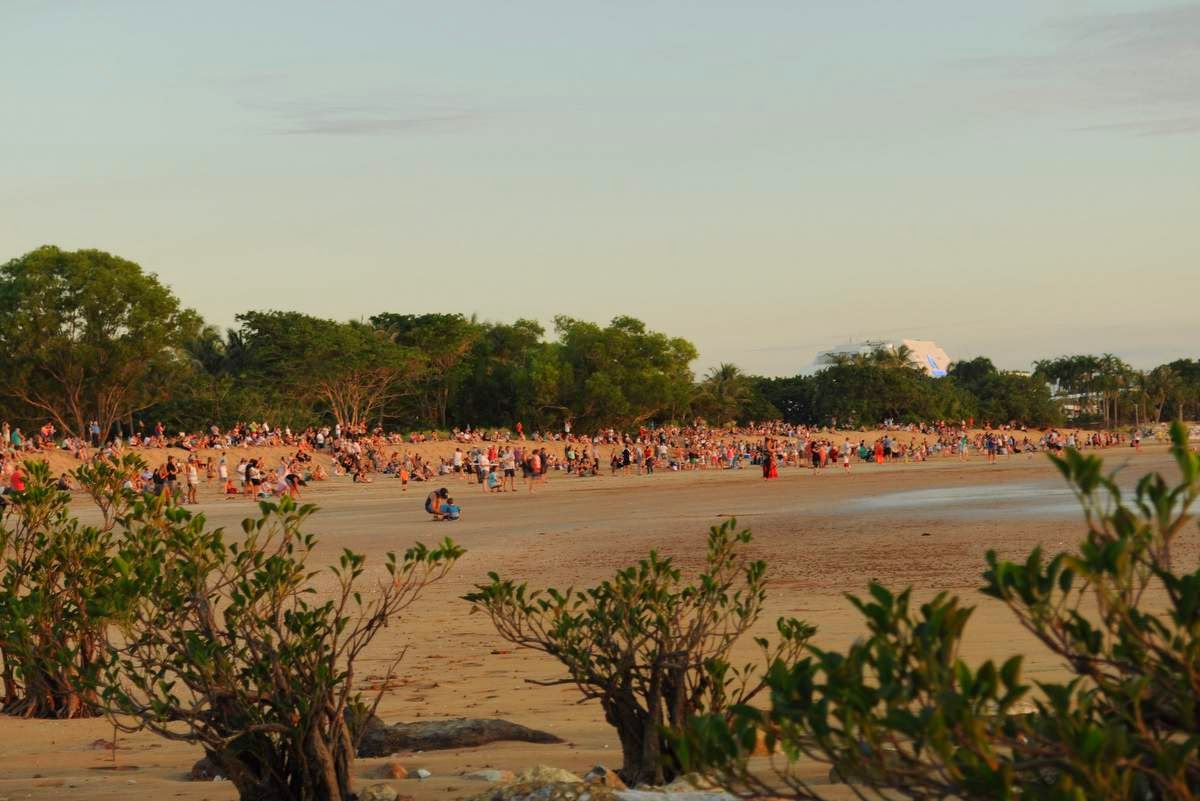
The sound of a didgeridoo player and drummer filled the air and we were drawn to the sound. A large crowd had surrounded them but I still managed to take a little video of them. What a wonderful sound. The “didge”player was using four different didgeridoos at the same time, each had a different tone. On the top of the sand dune behind the players were two little boys silhouetted against the evening sky, dancing to the rhythm. They were fun to watch. They were so unaware of being seen. Of course we had to go onto the beach to watch the sunset. 
It seems that all the tourists in Darwin had gathered on the beach to do just that! They made a wonderful shot too!
To draw my ramblings to a close, here is one of my sunset pictures. It was worth lugging the camera along!
AJ

Monday, May 20, 2013

Cooktown's splendors

Almost the entire morning was spent remembering James Cook, the seafaring explorer, cartographer and the man responsible for putting Australia on the map. Down on the river bank there are monuments to where the bark "Endeavour" was pulled up to the shore and repaired. The people of Cooktown have gone out of their way to make sure that every item that could be saved of that time has been preserved or even returned to Cooktown. A canon that was on board the ship was sent to them from where-ever it had been found.
Colin is standing on the top of "Grassy Hill" which is reputed to be the place that Cook stood and looked out to see the pattern of the river and coast so that he could plan his next moves. The water below Colin is that of the Endeavour River and Cook would have been anchored just below the trees in front of him.
The Botanic Gardens also had plenty of reminders of Captain Cook. I love looking through Botanic Gardens - but I am not good at remembering the names of plants! I want to share with you a couple of the pictures I took.
There were a few very large Malaleuca trees commonly known as Paperbark. The bark is soft and takes on many shade of gold and has been used artistically to make "bark paintings" which are very clever - tiny pieces of bark are stuck down to give a painted effect.
Bamboo was introduced to Australia and loves the conditions here! Colin helped to show the size of the bunch.
A pretty butterfly obliged by keeping fairly still for me, it was morning so there was still plenty of nectar in the flowers so the butterfly was having quite a feast.
One place that every visitor to this town MUST go is to the James Cook Museum. As the name suggests this museum is mostly about the man who captained the ship that landed here in 1770. I was amused that the stump of the tree to which the "Endeavour" was tied was preserved in the museum!
A very large anchor that is believed to be that of the "Endeavour" is housed behind glass along with a canon that was on board too. The anchor looks to be far too big for the size of the ship that Cook sailed in, it must have been very heavy hanging from the back of the ship - or maybe it was hauled on board. I shall have to investigate further!
A special treat for me was an outing in the company of this man, Wilfred Gordon. He takes people on tours of his country and shows off the ancient artwork that is hidden under rocky overhangs and helps his customers to understand a bit more about the Aboriginal culture of this area.We learned about some of the plants that were important to the Aborigines, about the edible ones and the toxic ones that once treated in a certain way, could be eaten. There was so much I learned and lots more I still want to know!
The artworks under the rocky shelves were almost in the dark and quite difficult to see until your eyes became accustomed to the light (or lack of it!). This picture was taken with the camera on "automatic" which meant that the pop up flash sprang into action. Although a false image because of its brightness it serves to show how much activity has gone on in this small area of about two meters. Red ochre is the crushed rock that was used for the illustrations in this area.
I shall recommend to anyone who is planning a trip to Cooktown to include a "Guurrbi Tour" by Willie Gordon. Everyone needs to learn more about the culture that many Aborigines have lost.
AJ
click on the pictures for larger images. Send any comments to joanren AT gmail.com