Showing posts with label history. Show all posts

Saturday, July 27, 2013

Good for the soul


I just love gardens so today was “right up my alley”! We visited the Hunter Valley Gardens. The gardens were opened in 2003 so are very new when compared to many of the large famous gardens to which tourists will flock. Our visit happened after all the rose trees had been pruned and all the deciduous trees – which actually is most of the trees – are still bare of leaves and buds are barely showing. In spite of that the gardens were beautiful. This photograph shows the formal garden and was taken from an elevated platform.
There are a number of different (very different) gardens within the 16 hectares of garden.
A little train is an excellent way to get the first taste of the garden and the train driver gives a running commentary as the train passes the different features. Anyone who is not so nimble will still be able to see most of what is in the gardens this way.
There are many topiary shapes that are really eye catching and even some that are shaped like animals! They are very clever!
The storybook garden is full of fascinating sculptures that would appeal to the child in anyone! This is more a garden of sculptures than a garden of flowers.
The time passed too quickly in the gardens but there was another interesting place to go and visit so we clambered aboard our mini bus and made our way to Singleton and to a convent where we were greeted by Sister Monika and given a fascinating look into the life of nuns in Australia. A little video was shown to us that gave the early history of the Order of the Sisters of Mercy and how the order started in Ireland before spreading across the world. Our guide had spent most of her life in this Convent and she was able to answer any questions we asked on any aspect of life as a nun.
Life has changed dramatically for nuns – they no longer wear the black habit and live in seclusion – but we were shown a Spartan room that showed how a nun’s bedroom (cell) used to be.
 
In the grand old buildings there were many beautiful stained glass windows. These have been repaired and strengthened without compromising their beauty. This is one of the glorious examples taken in the large dining room.
Just before we left the convent we were taken into the chapel – and this was definitely the “piece de resistance” The interior of the chapel is exquisite. The altar is Italian marble and breath-taking in its translucency and form. This is a very special place and I found out that I shouldn’t really have been taking photographs of it – but who could resist? I certainly couldn’t.
I felt so privileged to have been able to see this amazing convent, one that is still inhabited by nuns, albeit a small number of aging nuns, and to learn something of the contribution these ladies have given to Australia.
AJ

Monday, May 20, 2013

Cooktown's splendors

Almost the entire morning was spent remembering James Cook, the seafaring explorer, cartographer and the man responsible for putting Australia on the map. Down on the river bank there are monuments to where the bark "Endeavour" was pulled up to the shore and repaired. The people of Cooktown have gone out of their way to make sure that every item that could be saved of that time has been preserved or even returned to Cooktown. A canon that was on board the ship was sent to them from where-ever it had been found.
Colin is standing on the top of "Grassy Hill" which is reputed to be the place that Cook stood and looked out to see the pattern of the river and coast so that he could plan his next moves. The water below Colin is that of the Endeavour River and Cook would have been anchored just below the trees in front of him.
The Botanic Gardens also had plenty of reminders of Captain Cook. I love looking through Botanic Gardens - but I am not good at remembering the names of plants! I want to share with you a couple of the pictures I took.
There were a few very large Malaleuca trees commonly known as Paperbark. The bark is soft and takes on many shade of gold and has been used artistically to make "bark paintings" which are very clever - tiny pieces of bark are stuck down to give a painted effect.
Bamboo was introduced to Australia and loves the conditions here! Colin helped to show the size of the bunch.
A pretty butterfly obliged by keeping fairly still for me, it was morning so there was still plenty of nectar in the flowers so the butterfly was having quite a feast.
One place that every visitor to this town MUST go is to the James Cook Museum. As the name suggests this museum is mostly about the man who captained the ship that landed here in 1770. I was amused that the stump of the tree to which the "Endeavour" was tied was preserved in the museum!
A very large anchor that is believed to be that of the "Endeavour" is housed behind glass along with a canon that was on board too. The anchor looks to be far too big for the size of the ship that Cook sailed in, it must have been very heavy hanging from the back of the ship - or maybe it was hauled on board. I shall have to investigate further!
A special treat for me was an outing in the company of this man, Wilfred Gordon. He takes people on tours of his country and shows off the ancient artwork that is hidden under rocky overhangs and helps his customers to understand a bit more about the Aboriginal culture of this area.We learned about some of the plants that were important to the Aborigines, about the edible ones and the toxic ones that once treated in a certain way, could be eaten. There was so much I learned and lots more I still want to know!
The artworks under the rocky shelves were almost in the dark and quite difficult to see until your eyes became accustomed to the light (or lack of it!). This picture was taken with the camera on "automatic" which meant that the pop up flash sprang into action. Although a false image because of its brightness it serves to show how much activity has gone on in this small area of about two meters. Red ochre is the crushed rock that was used for the illustrations in this area.
I shall recommend to anyone who is planning a trip to Cooktown to include a "Guurrbi Tour" by Willie Gordon. Everyone needs to learn more about the culture that many Aborigines have lost.
AJ
click on the pictures for larger images. Send any comments to joanren AT gmail.com

Friday, March 1, 2013

The angry sea

Although I am now in the comfort of my own home I have not stopped thinking about the things that were seen on my four days in New South Wales. This evening I am looking at a few of the shots I took while at Evans Head. There is a small trawler fleet tied up in a safe little rectangular port, they create a beautiful picture as they lie quietly in their safe patch of water.
The trawlers mostly leave to work through the night but with the sea as angry as it was on the day of our visit I would imagine that catches would not be worth the danger the boats would be in as they struggled to escape through the rolling water in the mouth of the bar.
A drive up to the look out at the top of the rise gave an even better idea of how dangerous the sea might be to small fishing vessels such as we saw earlier.
The Evans Head Bar has long been a problem to shipping and an excellent reminder of this sobering fact is the huge anchor that resides as an eye catching ornament close to the lookout.
The plaque near the anchor gives the story - I know it is a bit difficult to read but since I don't drive around with soap and scrubbing brush when exploring I was unable to clean it up to make reading easier!
Do remember that by clicking on the picture it will enlarge so reading this plaque will be a lot easier than it was for me at Evans Head! The sign is from foot to knee level - not the easiest height for reading!
AJ


Tuesday, February 26, 2013

Unexpected history


This morning saw my little red Corolla parked in the busy main street of Ballina, a town only ten minutes drive away from where Colin and I are staying.. It is a lovely drive too, the road runs along the cliff tops overlooking the sea and the occasional sighting of the angry ocean was breath-taking. If anything the waves are more unsettled than they were yesterday with the white of the breakers stretching back almost to the start of the following wave. Unfortunately there was no where to pull over to take a photograph so it has to remain etched in my memory! Its a good job I can't show you what is kept there!
Ballina is both old and new.
The distinctive architecture of the Court House Offices has been a feature of Ballina since its earliest beginnings as a town – which by European standards is not long! Probably 1912.
Contrasting with the austere styling of the Court Offices is the very modern looking Library. This building is not the only modern styled one in the town. This indicates a vibrant and progressive community and council, one that is both modern an believes in preserving the good things of the past.
You may notice the difference in the sky between the first and second photograph. When we arrived there were patches of blue sky and we were hopeful of doing plenty of exploring. It is less than a hundred metres from the Court House to the Library and in that time the blue had almost vanished. We rounded the corner to enter the building next door – the Information Office – and almost as soon as we closed the door it was raining.
A very helpful young man advised us on places to visit and gave us a couple of maps that will be very useful. Our plan was to take a look through the Naval Museum just across the road but for that we needed the big umbrella and big strides! The rain was pelting down! Off we splashed and laughingly made our soggy entrance.
What an amazing collection! I am not really a museum enthusiast but what was kept in this building really sparked enthusiasm. There were dozens and dozens of the most incredibly detailed models of ships from both the first and the second world wars. Wonderful large scale models – some made wholly from copper and brass – (sails as well, made from copper sheet)
The most amazing exhibit is La Balsa. The raft that was used by an intrepid explorer to traverse between South America and Australia.
Balina itself has quite a nautical history, the volunteer at the entry told me that the river was once one of the busiest ports on the east coast, rivalling the port of Sydney. There is a mural on one of the walls of the museum that depicts that time. Can you see the Court Office building?
A sailor at the wheel is at the entrance to the area that contains the second world war maritime history.
In this second part of the museum are many more model ships of ships from Japanese, English, American and German navies as well as Australian. Plus there are little dioramas that give an insight to life on board a war vessel.
Leaving this fascinating place was as difficult as getting into it. The rain was even heavier and the road and pavements were awash with water. That decided us to return to the dry comfort of our unit and wait until the weather calmed a bit before venturing out again!
AJ

Monday, August 6, 2012

Coffee in the country

It was a perfect Sunday, plenty of warm sunshine and petrol in the car. So warm that most people drove to the beaches so Colin and I drove in the opposite direction and into the country. It was a good choice, there was barely a car on the road!
We stopped and purchased bananas and avocados from a grower and pulled over to take photos of the magnificent scenery and wasted our time in a manner we both enjoy.
 A canefield that has been harvested allowing a clear view across to Mt Warning. A mountain named by the explorer Captain Cook because he felt that it would serve as a warning to shipping about a reef that was off the coast of NSW.
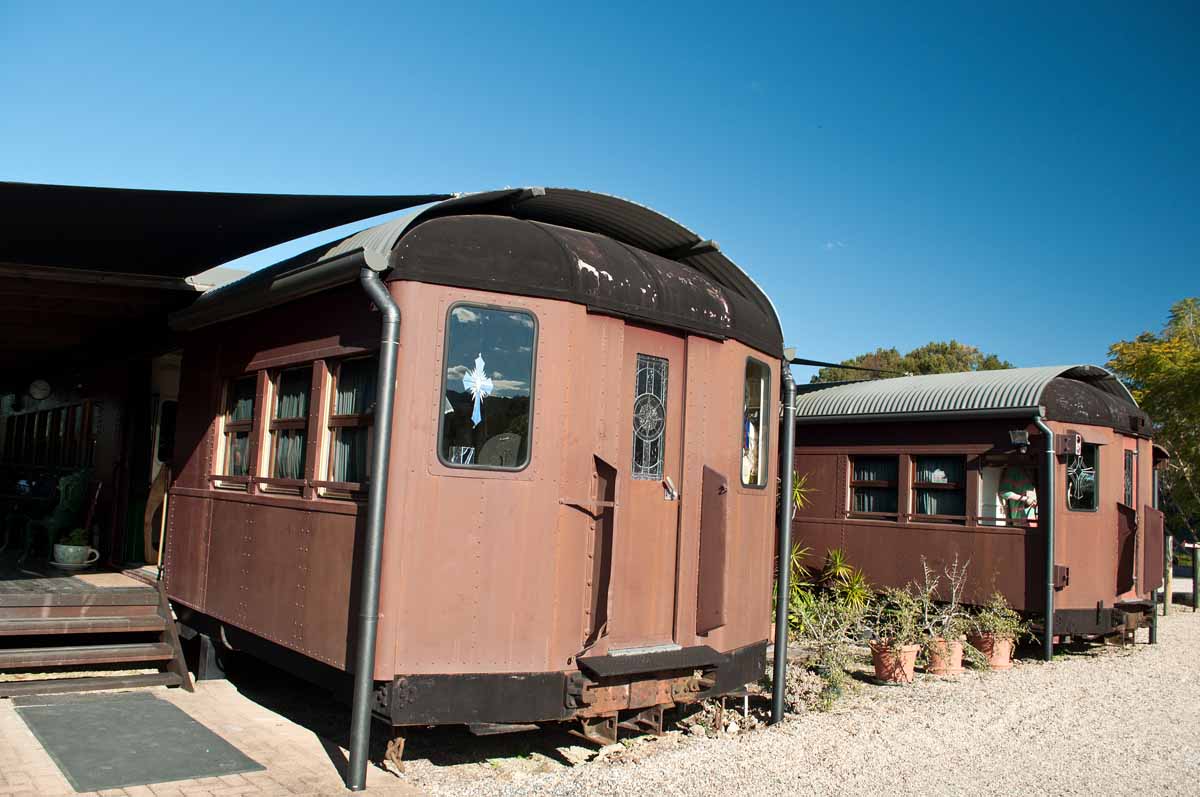
When we saw a couple of railway carriages through a gateway and a sign indicating that coffee and cake were available, we stopped
The Cafe cum craft gallery is called the "Red Rattler" however the red paint has faded in the weather and looks a little drab. We drove the car down the drive and parked in the huge carpark next to this signboard.
There was no chance of a rail motor passing since there were no rail tracks! The sign added to the fun atmosphere though.
I poked my head around the door of the first carriage - both were linked with a timber board floor and shade sales - and this carriage was filled with nick-knacks of every description. Paintings adorned the walls, stain glass light catchers hung from everywhere and if anything could be hand crafted and sold, it was here.
Being quite capable of creating my own craft and not wanting any more I moved on down to where we could order a coffee. While waiting for it to be made I poked my camera into the second carriage - this one had been set out as a dining room - there was even a piano (playable) in the guards compartment at the end!
We did enjoy our brief visit to the Red Rattler, the coffee was good, the staff happy and pleasant and the carriages fun to visit.
With plenty of memory still left in my SD card I was impatient to move on and find more subjects to aim the camera at!
AJ


Saturday, May 14, 2011

My town

I always seem to be writing about "other places" so today I decided it was about time to point the camera at my own little town. Mudgeeraba grew from a small settlement of ceder cutters - timber-men and their families - and is now a town and district that has five large schools to accommodate all the children! A delightful statue that is a tribute to the ceder cutters stands in the "Village Green", a little park in the centre of the town.
f/6.3   1/200  ISO 200

The plaque beneath gives the story of Mudgeeraba - click on the image to see it large enough to read.

 f/6.3  1/100  ISO 200
The timber building that is called "The Old Post Office" was once the Shire offices, it was the Post Office when I first moved to Mudgeeraba. and I was fortunate enough to be able to interview, on video, the post mistress just prior to the closing of the doors in 1993.
f/6.3   1/100   ISO200
A feather was put into Mudgeeraba residents' hat when the town was given a special award in 2009, it was chosen as the "Friendliest town in Queensland"! So timber sign boasts to all who drive into the cutting that gives access to the small town.

 f/6.3   1/100   ISO 200
The Wagon wheel and axe are the symbols of Mudgeeraba's heritage, below the wall is the timber sign that tells of the Friendliest Town award. The black rectangles are spot-lights for the two signs.
In the main part of the town - around the Village Green - the buildings have been constructed in such a way that they echo the history of the area. They are not genuine old buildings at all, they have been built in the last 20 years. The rounded roofs are called bull-nose roofs and that shape is typical of buildings in the early 1900's as is the colouring of the walls and veranda railings. These are "heritage colours".
f/6.3  1/100  ISO 200
The Wallaby Hotel has been in Mudgeeraba since 1883 - what we see now is not the original but renovations of the original! Somewhere under all that weatherboard and paint there are a few original timbers! This part of the hotel is renovated in a very similar style to the original however the place is so much bigger than the original and has a large modern restaurant that is off to the right of the photo.

 f/6.3  1/160   ISO 200
I did consider doing some "Photoshop work" on this picture to remove the severe lean - but I rather like the look as it is, so left it! To straighten it would have meant losing quite a bit of the picture, including the top.
 Finally I am including a shot, which wouldn't win any prizes for composition - but it goes to show the proximity of the main Brisbane motorway to the entrance to the town. The wooden signs shown in an earlier photo are just on the right of this shot.
 f/6.3  1/125  ISO 200
The signs are on the corner of this road. Just the other side of the service road is the M1 and you can see some of the cars whistling past and missing the beauty of my little town.
For those of you interested in photography and the settings I used.  Today I used Manual because it was the middle of the day and the shadows were rather heavy and aperture priority gave either over or under exposure. I set the aperture to what I wanted and then adjusted the shutter speed to get the correct amount of brightness. The beauty of using a digital camera is that you can make mistakes and learn from them!
AJ

Wednesday, May 11, 2011

In the old style

Murwillumbah is a small, busy town with almost every building in the main part of town a slice of history. Murwillumbah came into being in 1902 and the name is taken from the aboriginal language of the time.It roughly translates to "camping place" – from Murrie, meaning "aboriginal people", Wolli, "a camp"; and Bab, "the place of" (Thanks to Wikipedia for that translation!)
While the shop fronts look modern (in many cases) the upper story of the buildings tells a different tale.
f/13    1/80    ISO 250    38mm
Each one is a different style and a different colour.
 f/32    1/50    ISO 250    35mm
The Commonwealth Bank is very impressive with Grecian pillars.
 f/16    1/60    ISO 250    18mm
The most necessary building in any town of this size, is the Police station. The Police Station in Murwillumbah is very similar to timber police stations in many country towns. It looks cosy rather than foreboding. The little lock-up next door does not look quite so welcoming, though! Standing right next door to the lock-up is the court house so all these important buildings are together in the centre of town.
 f/6.3    180    ISO 250    18mm
Murwillumbah (we locals pronounce the name mer - wool - um - bah)
One of the famous people who call Murwillumbah home is Stephanie Gilmore, the young surfer who took the world by storm on the waves and holds four world titles.
AJ

Sunday, May 8, 2011

Art in the country

Small towns are often full of surprises and one little place not far from where I live - but over the state border in New South Wales - is a little beauty. It is as small as a postage stamp and yet it attracts bus-loads of visitors every day and bigger crowds at the weekends. The town's name is Stoker's Siding. The little town started life as a dairy farm but a railway siding gave the necessary impetus for the town to grow. The reason the visitors love this place is due solely to the marketing skills of a very talented potter, everyone who comes here goes in to see the pottery and crafts that are for sale in a building that is close to 100 years old.
 f/7    1/100    ISO 250    22mm
The old building was once a general store and it has been lovingly maintained in its original form and is a photographer's delight! The panes of glass decorating the space above the main windows are not seen like this any more.
 f/5.6    1/100    ISO 250    20mm
I was rather taken by the unusual glass creations that were hanging inside the main display window. It was a bit difficult to take a photo of them with all the reflections on the glass - and even the circular polariser did not help very much.
 f/3.5    1/100    ISO 250    18mm
Inside the place is filled with the most exquisite pottery, paintings and works of art. If you want to see unusual glazes and huge platters and special pieces of pottery - this is the place to come!
 f/3.8    1/100    ISO 250    20mm
The train that converted Stokers Siding to a town has ceased to run and the grass grows tall between the rail lines, there are no noisy trains to disturb the peace any more neither to stop here nor to travel further north to Murwillumbah. The cows can graze in peace and quiet once again.
 f11    1/100    ISO 250    50mm
The children must travel by school bus to Murwillumbah every morning and some creative parent has decorated the bus shelter. This must be one of very few bus shelters that does not have graffiti all over it.
 f/3.5    1/100    ISO 250    18mm
Even if you have visited Stokers Siding before, it is always worth another visit. The artwork in Stokers Siding Pottery is always changing and always interesting - and a new business that will attract visitors has opened next door.
AJ

Friday, April 23, 2010

Further up the Rail Trail

This is our last day for exploring the country around Wanaka so with picnic basket packed we set off to explore further along the Central Otago Rail Trail and kept the car rolling until we had driven past the places at which we had stopped yesterday. It meant a long stretch of driving – over two hours non stop – but once we started to explore new country that distance was forgotten and the cameras were kept busy. 1/60 f/8 ISO 200
Our first stop of interest was a watering hole that has become busy thanks to the development of the cycle track along the old railway tracks.
1/100 f/8 ISO 200
Wedderburn has a namesake in Australia but other than the name there is no similarity at all. This Wedderburn totals one old hotel and one back packer farm-stay. The hotel is built from what looks to be local stone, but I suspect that it has been restored and refurbished a few times since its original construction. The summer outside garden area is enclosed with the same stonework and the way it has been done gives character to a functional area. What amused us was the line-up of vehicles for hire near by. We wondered where the people would come from to hire these vehicles! Surely the cyclists wouldn’t want them!
At a T Junction I made a decision to turn left to see what Naseby looked like. It was only 15k up the road so not far. What a gem this place turned out to be! It is not on a through road, the road goes no further, and yet the town is quite sizeable and full of the most interesting buildings dating back to the late 1800’s. We locked the car and walked around taking plenty of photos of a town that seems to have been stuck in time. The shops that were open seemed to be selling junk from that era too!
The only picture of the buildings I am sharing with you is of a haberdashery on the corner.

1/180 f/6.9 ISO80 (p & s Samsung N50)

The little dark painted shop next door to it is a clock and optical shop! What a combination. Get your clock fixed while you try on some new spectacles! The items in the window were fascination and both Colin and I managed to take a couple of shots of them. It’s no good. I shall have to show you one of the pictures I took! Like I said, it is as though the place has been stuck in time, this display looks so natural! 1/60 f/3.9 ISO 100 (p & s Samsung N50)

As it was time for lunch I pulled the car up beside a grassy area with some dark and healthy fir trees. On taking a second look at the trees I was amazed to find that these trees had been planted in 1880 after being brought from different parts of the world, there was a tree from Afganistan, one from Canada, and the two huge Wellingtonia (Sesquoiadendron giganteum) were from California, USA. (there were labels on the trees!) You can tell from the size of our tiny red Toyota Corolla just how big these trees are!

1/180 f6.3 ISO 80 (p & s Samsung N50)
Another unexpected find was a german gun - sorry I am not interested enough in weapons to know what sort of gun it is! The NZ soldiers from Naseby who won the particular battle and comandeered this gun had it shipped to England and then it was send on to NZ where it eventually wound up at Naseby. When you drive the country roads for miles and miles and see nothing but hills and sheep it is a real surprise to learn that the soldiers from this little town were presented with this trophy! And look how new and well preserved it looks! It doesn't look as if it is nearly 100 years old.1/180 f/6.3 ISO 80 (p & s Samsung N50)
Our next town visited was Ranfurly and it is different as it could possibly be from Naseby. This town is quite large too but its buildings are mostly 1950s and are of the Art Deco style. We walked into one of them and found ourselves confronted by a delightful volunteer who really enjoyed explaining about the towns we had visited. She had some stories of her own travels to share too so it was difficult to tear ourselves away!
This evening we pack our cases in readiness for the long trek back to Christchurch. Just as we had promised ourselves, we shall be taking back to Australia a large chunk of New Zealand in our memory cards!
AJ